Revisions to fiscal consolidation targets
If the average yield on government debt is equal to the rate of nominal GDP growth, a primary balance surplus will occur simultaneously with a reduction in the government debt-to-GDP ratio, making them consistent as fiscal consolidation goals.
In practice, however, the relationship between the average yield on government debt and nominal GDP growth tends to be quite volatile in the short term, and the two indicators do not necessarily track each other.
For this reason, previous administrations treated a primary fiscal surplus as the primary target and a falling debt-to-GDP ratio as a secondary objective. I suspect they intended to shift their attention to the latter once the former had been achieved.
The current administration, however, intends to make the debt-to-GDP ratio the main target even though it has yet to achieve a primary fiscal surplus, effectively reversing the priority of the two targets. The target of a primary fiscal surplus will not be abandoned, but the government will not view a single-year deficit as being problematic. I suspect financial markets will view this as a loosening of fiscal consolidation targets.
Debt-to-GDP ratio is lagging indicator
However, I believe the decline in the debt-to-GDP ratio is a temporary phenomenon resulting from the rapid inflation of the past few years. An abrupt rise in the inflation rate produces a significant increase in the denominator of the debt-to-GDP ratio (GDP), while the numerator (government debt) rises more gradually. A key reason is that even if inflation produces higher yields on newly issued JGBs, it takes time for that to drive the average yield on all outstanding debt higher as bonds mature and are refinanced.
Today's historically high inflation means the debt-to-GDP ratio is a lagging indicator of fiscal consolidation and is thus less useful than in the past.
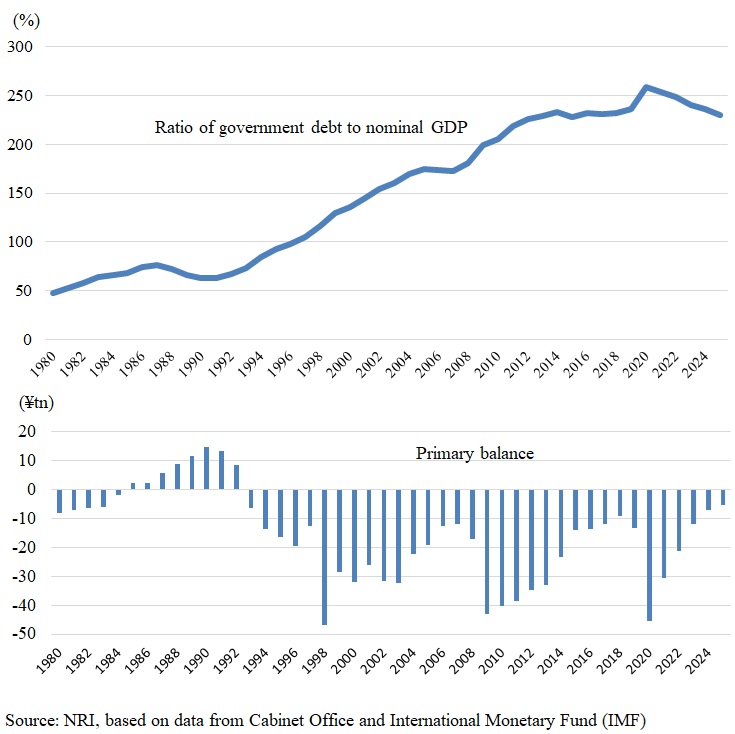
If the government cites the declining debt-to-GDP ratio as a rationale for pursuing proactive fiscal policy, I believe it will eventually bring about a sharp rise in the ratio and deeply undermine market confidence in fiscal policy. The ability of looser fiscal consolidation targets to fuel market concerns about a loss of fiscal discipline should not be ignored.
Profile
-
Takahide KiuchiPortraits of Takahide Kiuchi
Executive Economist
Takahide Kiuchi started his career as an economist in 1987, as he joined Nomura Research Institute. His first assignment was research and forecast of Japanese economy. In 1990, he joined Nomura Research Institute Deutschland as an economist of German and European economy. In 1996, he started covering US economy in New York Office. He transferred to Nomura Securities in 2004, and four years later, he was assigned to Head of Economic Research Department and Chief Economist in 2007. He was in charge of Japanese Economy in Global Research Team. In 2012, He was nominated by Cabinet and approved by Diet as Member of the Policy Board, the committee of the highest decision making in Bank of Japan. He implemented decisions on the Bank’s important policies and operations including monetary policy for five years.
* Organization names and job titles may differ from the current version.