
Ryota Uzu, IT Consulting Department for Industrial-Sector I
Koki Iwamatsu, Systems Development Innovation Solution Department
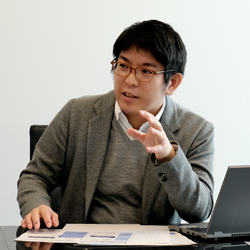
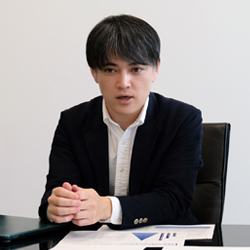
As system improvements and modifications pile up endlessly in response to business changes, the result is often bloated and overcomplicated legacy systems. At NRI, we have spent years helping countless customers modernize their legacy systems. But what kind of approach does successful modernization demand in the age of AI? NRI’s Ryota Uzu (above, right) and Koki Iwamatsu (above, left) share their expertise in these fields.
The Three Approaches to Legacy Modernization
Regarding the causes of this, Uzu notes, “The biggest barrier to reform of legacy systems is the difficulty of reaching agreement with the people concerned.” All people have a tendency to view “what we have now” as natural and inevitable, and although IT departments, which understand the crisis of the persistence of legacy systems, are trying to launch reforms, often they are hounded by the divisions that use those systems or by upper management about why companies should spend so much just to remake what they already have, or whether such projects are really worth doing when they produce no new value. This has an impact on the direction of the projects themselves, often resulting in the abandonment of more radical reforms. In many cases, modernization ends up stopping at minimal, end-of-life measures.
“Legacy modernization can be divided broadly into three categories, depending on its objectives,” Uzu explains. The first category, which includes the reactionary measures noted above, is solving system problems to avoid business continuity risks; the second category is solving problems to facilitate data-driven management; and the third category is acquiring an operational and IT infrastructure that is optimized for business enhancement.
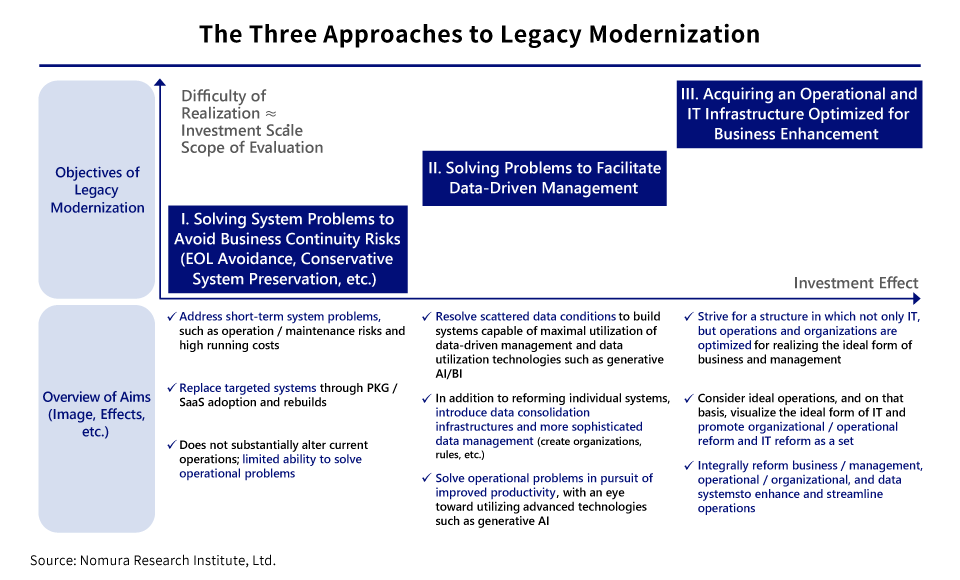
The optimal approach differs depending on the company, the business, and the system. For businesses and operations that are not changing significantly despite the changing times, the first approach can be effective, but for systems facing circumstances where the market environment or business strategy is experiencing massive change and the ideal form of business is being reassessed, the third approach is needed. Uzu explains, “We often hear from clients that are in dire straits because they haven’t done the work of figuring out what approach they need and instead have launched a scattershot array of minimalist projects to solve system problems, resulting in a proliferation of new legacy systems.”
Frameworks for Avoiding a Repeat of the “2025 Digital Cliff”
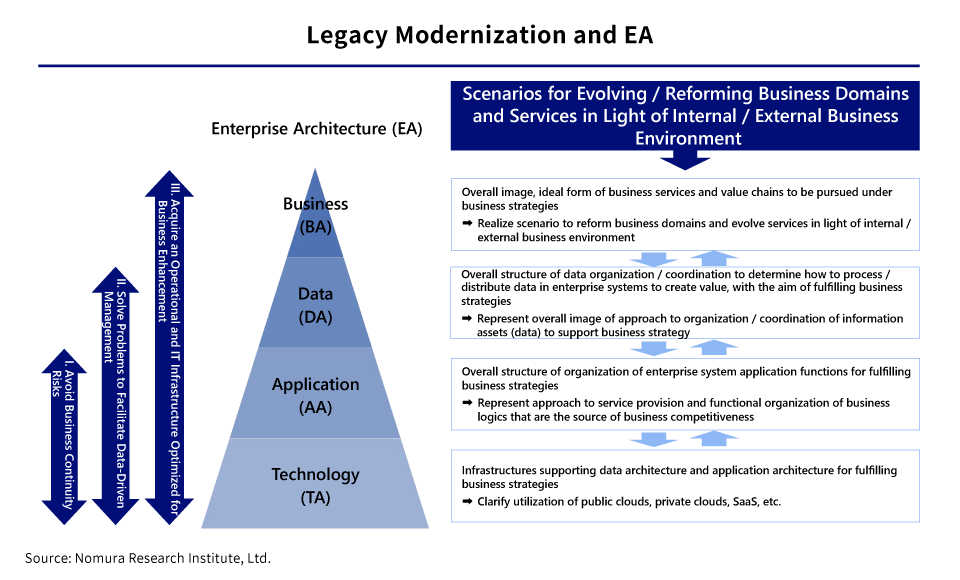
“By utilizing EA as a framework,” Uzu explains, “companies can take a comprehensive and organization-wide view of their operations, data, and systems, anticipate and prevent the disagreements that arise between stakeholders, and lower the hurdles to ensuring operational and systemic coherence while reforms are in progress. This provides a foundation for promoting sustainable modernization for the company as a whole.”
Generative AI Utilization is Effective for Achieving Sustainability
“The essence of modernization is eliminating existing technical liabilities so your company can maintain medium-to-long-term competitiveness. In other words, modernization is not a question of ‘do it once and you’re done,’ but of implementing reforms over and over in accordance with environmental changes. To do that, you need to establish the most efficient systems possible to ensure that you’re minimizing workloads and implementation times.”
Such streamlining, however, is often hampered by the difficulty of analyzing current conditions. Legacy systems that have been in operation for long periods of time often end up mixing architectures from different eras because of the cumulative effect of repeated expansions and rebuilds, and the result is often massive and unwieldy systems encompassing millions of lines of code. Personnel who understand the once-current design diagrams are lost to retirement or turnover, and once systems become black boxes, it can take years to make sense of them. This is the biggest factor undermining the agility of business.
A further obstacle is the burden of testing processes. According to statistics from the Information-Technology Promotion Agency, Japan (IPA), testing processes account for approximately 30% of standard system development. In modernization where continuity of existing functions is required, this percentage can be even higher, creating a barrier that discourages ongoing reform.
“Generative AI is one pathway to solving these problems,” Iwamatsu claims. “By combining generative AI with the program analysis technologies NRI has cultivated already, it is possible, even when design specifications don’t reflect reality, to use program code to generate the definitions of data to be included in specifications, as well as other information that requires a high level of abstraction, such as the business requirements underlying implementation. At NRI, we started experimenting with this in 2023 and began trials on actual projects in July 2024.” In actual practice, these methods have been employed on some finance projects, where they have substantially mitigated workloads relative to past projects conducted manually.
Generative AI has helped streamline more than just current analysis, demonstrating effectiveness in planning, design, and coding, as well as in tests that have bottlenecked. Technologies that automatically generate test cases and data from current code and analytical results are currently being evaluated and deployed, and the powers of AI are also showing up in conversions of code from old languages such as COBOL. Previous conversion tools were often constrained by the formats of old languages and thus required veteran technicians to make sense of things, but generative AI utilization allows old code to be converted into natural code that does not inherit the habits of the old languages. At the same time, documentation now can be created automatically.
“Human and Organizational Problems” Are at the Root of Legacy Systems
Another important factor seems to be having partners that can act as close allies along the journey.
“When I join client projects as a consultant,” Uzu says, “I participate with the mentality that I am not an NRI employee coming from outside, but a client employee with NRI expertise. To achieve this, I thoroughly research the client’s situation in advance. I also adopt the mindset that I need to be a half-step ahead from the client’s perspective. Being behind the client would be out of the question, but if I’m too far ahead, they won’t understand me.”
In closing, Uzu observes that ultimately, it is “human and organizational problems” that are at the root of legacy systems. Adopting the proper approach to these problems may be the most important key to success.
Profile
-
Ryota UzuPortraits of Ryota Uzu
IT Consulting Department for Industrial-Sector I
Joined NRI in 2009. Specializes in system consulting services, including business process transformation planning, IT strategy and system planning, and management support for large-scale system development projects.
In recent years, focuses on CDO/CIO agendas such as digital organizational transformation, digital-driven business and operational innovation, and legacy modernization, supporting transformation initiatives in the manufacturing industry and related sectors.
-
Koki IwamatsuPortraits of Koki Iwamatsu
Systems Development Innovation Solution Department
Joined NRI in 2012. Assigned to Advanced Information Technology Division. At the Pacific Branch of Nomura Research Institute IT Solutions America, Inc., conducted research into applying AI to modernization and supported partnerships between startups and Japanese corporations.
Currently a member of the Center for Systems Development Innovation, he draws on expertise in fields including software architecture and AI security to facilitate new business launches and venture partnerships.
* Organization names and job titles may differ from the current version.