
Hiroyuki Hayashi, Marketing Strategy Consulting Department
Sakura Fujisaka, Management Consulting Department
As the evolution and spread of generative AI continue to accelerate, different countries are showing significant differences in their use and acceptance of the technology, with Japan emerging as a frequent target of claims that its AI utilization is lagging behind. However, detailed examination of the facts on the ground reveals a Japan-specific state of affairs that is much more than a simple “lag.”
In September 2025, NRI conducted its “International Comparative Survey on AI Use” in Japan, the U.S., China, and Germany, performing a multifaceted analysis of generative AI use and acceptance among consumers. Based on the results of that survey, this article assesses current conditions in Japan and considers the possibilities for the spread of AI going forward.
Current Conditions in Japan, Observed through the Actual State of AI Use
Likewise, the percentage of respondents using paid AI services was 15.5% in Japan, a very low level. In light of the figures for the U.S., Germany, and China (40.2%, 33.9%, and 66.0%, respectively), the scale of monetary investment in AI appears to be quite limited in Japan.
These results are partially a reflection of differences in these respective countries’ systems and market environments. The Chinese market, for example, is influenced by the functional constraints of the AI services offered by domestic companies and, in effect, often presupposes the use of paid services. Japan, in contrast, has many services that are available for free, and conditions there indicate that “trying it first” does not always lead to ongoing use or to the use of paid services.
Japan’s Distinctive Stance: “We Trust It, but We Don’t Use It”
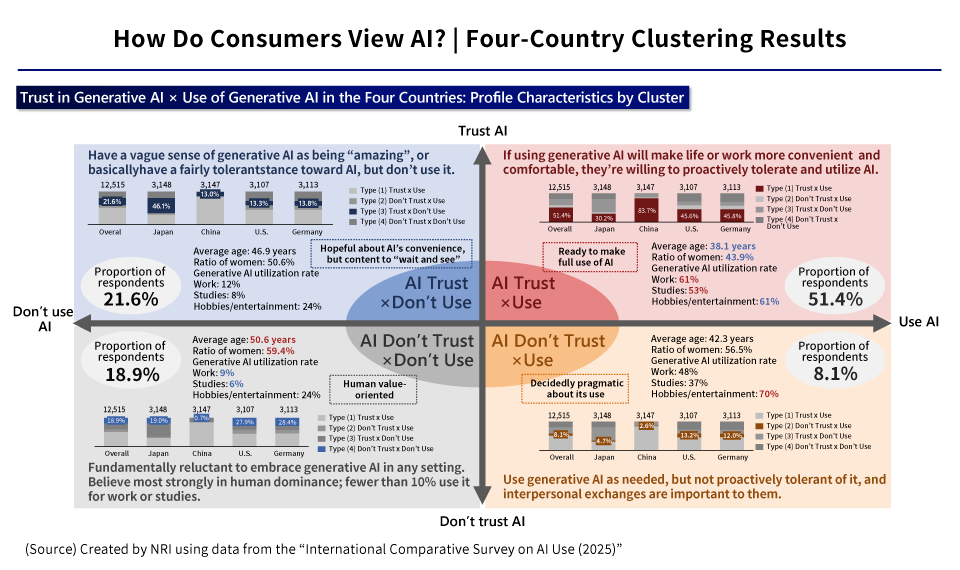
On the other hand, in the U.S. and Germany, there were a certain number of people who used AI from a pragmatic or utilitarian perspective despite not necessarily having high trust in it. Likewise, in China, national strategy and the spread of platforms have spurred deep integration of AI into daily life and industrial activities, suggesting that people there are no longer in the stage of deciding “to use or not to use.”
Comparison of the four countries thus reveals differences in how each is handling the relationship between “trust” and “use.” More specifically, the U.S. and Germany have moved ahead with utilization despite not necessarily having high trust, while in China, AI use has taken hold as a part of social infrastructure. Conversely, Japan seems to be characterized by a trust in AI that is not linked to use of the technology.
The picture that emerges from these differences shows that Japanese consumers are cautious about AI but not necessarily negative about it. In fact, conditions appear to suggest that they have expectations for the technology, but no impetus to use it or no sense of necessity about its use.
The Receptiveness Perspective: “If We Use It, It Will Grow”
In addition to these overall trends, the survey examined whether there were differences in receptiveness depending on the state of use of AI. Consumers were classified according to frequency of AI use, and receptiveness to AI was compared across groups.
The results showed that for functions that work as extensions of everyday life, such as proxy buying of everyday items or advanced information gathering, the groups most apt to use AI on a day-to-day basis were also the most receptive in their attitudes toward it. This indicates that AI is most likely to be accepted in areas that allow consumers to imagine specific conveniences, rather than abstract visions of the future.
The results also confirm that people who use AI more frequently tend to be more receptive to an AI-driven future. This means that positive evaluations of AI are being formed through the actual experience of using it – or, put differently, that there is a cyclical pattern where use leads to deeper understanding, which in turn leads to greater receptiveness.
Conditions for the Spread of AI in Japan
Japanese consumers already have certain expectations about what AI will do for them. Therefore, the essential question is how to create opportunities for people to begin using AI naturally in everyday life.
Achieving this goal will demand not only easy-to-understand applications like work streamlining and information searches, but service designs that are tailored to individual life. For example, one of the keys will be utilization in areas that directly improve quality of life, such as purchasing support, healthcare, and learning support.
Also important is the question of how to provide, through ingenuity in UIs and experiential design, the initial experience of “I tried it, and it turned out to be helpful.” It appears likely that this first step will determine whether use continues and acceptance grows thereafter.
The Case for Japan: Potential, not Lag
This means that a change in perspective reveals massive potential, because there are hidden possibilities for Japan’s AI utilization to be expanded in no time, simply through the creation of appropriate impetuses for use.
Looking ahead, the vital point will be not the sophisticated functions of AI in themselves, but the question of how to provide experiences that enable consumers to begin using AI naturally. The accumulation of small successful experiences at the day-to-day level will further deepen understanding and trust, leading to growth in use.
What awaits beyond that transformation is more than a simple efficiency enhancement; it is a change in the very character of life and of work. As AI takes over routine operations and information processing that humans cannot handle, people will be able to spend more of their time dealing with exceptional situations and making fundamental judgments.
This, in turn, will bring about a change in values with regard to employment, as well as a further increase in the importance of the judgment and creativity that only humans can exercise, relationship-building with other people, and other similar factors. In addition, from a customer service perspective, functions such as information provision and procedures will be entrusted to AI, with the role of humans shifting to areas of higher added value. Japan today stands at the cusp of a transition toward these changes.
Profile
-
Hiroyuki HayashiPortraits of Hiroyuki Hayashi
Marketing Stragegy Consulting Department
Joined NRI in 2015 after a period with a foreign consulting firm. Since joining, he has been involved with the “Questionnaire Survey of 10,000 Consumers,” assuming the role of coordinator in 2018.
His childhood dream of becoming a scientist led him to study plasma physics in university. However, he eventually became interested in marketing and consumer research and moved into the consulting industry.
The driving force of his daily activities is a desire to use his current work to give back to society. -
Sakura FujisakaPortraits of Sakura Fujisaka
Management Consulting Department
* Organization names and job titles may differ from the current version.