NRI INDIA Yutaka Go, Satoru Ishigaki, Yusuke Numata, Dai Watanabe, Mai Hasegawa, Tatsuki Himono, Yudai Sasaki
India has long drawn attention as a massive consumer market. In recent years, however, its status has been changing. With its ongoing infrastructure development, growing concentration of R&D functions, and increasing use of digital talent, the country has begun to evolve into a base for launching new products, technologies, and services on a global scale. The essence of this current transformation lies in how India has, so to speak, begun to play the role of a “global hub”.
How should we interpret this kind of structural change? In this piece, we identify where India’s economy currently stands, looking at trends in five key industries that are gaining attention in the Indian industry.
Why India, and Why Now? by Yutaka Go
India is projected to surpass Japan in terms of GDP in 2026 and is on track to become a leading global economic superpower. It is already home to the largest population of any country in the world, and the robustness of its labor force, especially its younger generations of workers, is a major strength. In addition, it has a large base of IT engineers and AI talent and is the world’s third-largest hub of unicorn companies, for example, which are part of what is making the country increasingly competitive in the digital field.
What has bolstered this growth is a series of industrial policies promoted by the Modi government. The “Make in India” campaign aimed at promoting the country’s manufacturing industry and the “Self-Reliant India” mission which seeks to enhance its economic independence are characteristic initiatives of this approach. Furthermore, through individual policies such as the Semiconductor Mission and the AI Mission, efforts are being made to encourage investment in cutting-edge fields and to build ecosystems. Budget allocations to infrastructure development and industry promotion are also continually being augmented.
However, the proportion of the manufacturing industry to overall GDP still remains at a little under 20%, and so by no means is industrialization progressing rapidly. It’s apparent that this is because the IT and software industry is leading India’s industrial growth overall, with digital infrastructure driving along other industries like retail and services. In fact, the concentration of design, R&D, data processing, and other advanced capabilities that’s begun to take place is precisely a distinctive trend in India’s current industrial sector. In light of these developments, India is arguably transforming in nature from merely being a massive consumer market into a base for launching new products, technologies, and services on a global scale.
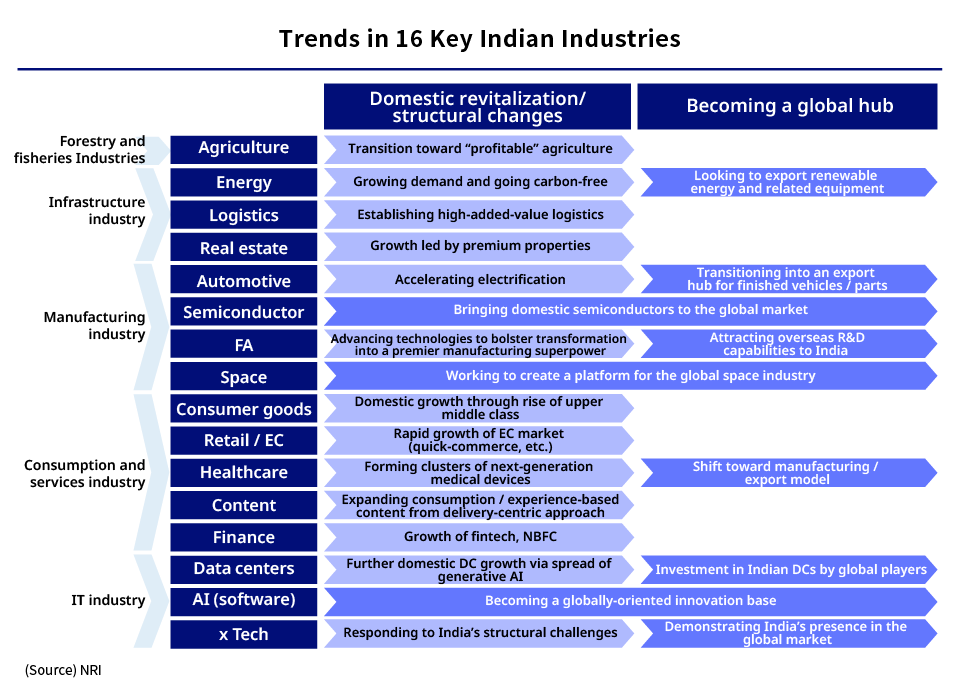
Trends in Five Key Industries by Satoru Ishigaki, Tatsuki Himono, Mai Hasegawa, Dai Watanabe, and Yudai Sasaki
Up to now, India has demonstrated its strength in the semiconductor design process. Meanwhile, it remains dependent on imports for its semiconductor manufacturing process, and in particular, it’s high reliance on China poses a key challenge.
Going forward, India’s domestic semiconductor demand is expected to steadily climb alongside advances in digitalization and the growth of the automotive and communications sectors. Against the backdrop of this growth in demand and the need to remedy this structural reliance on imports, the government has launched full-scale efforts to build up its semiconductor manufacturing base.
In addition, given the increasing geopolitical risks, semiconductor manufacturers in various countries are looking into or actually moving forward with building manufacturing sites or strengthening their supply chains in India. Although infrastructure-related problems including those involving electric power and water resources still remain, with growing domestic demand, policy support, and international supply chain restructuring efforts acting as a tailwind, India can be said to have entered a new phase in the form of a manufacturing ramp-up. This change also has implications for Japanese companies: there is potential for them to contribute not only in terms of back-end processes, but also in components and materials as well as front-end processes.
■The Space Industry ―― Transitioning From Government-led Initiatives to Private-Sector Growth by Tatsuki Himono
India has a strong track record in space technology, including the success it’s had with its lunar exploration program. While this effort thus far has primarily been government-led, in recent years the space field has increasingly opened up to the private sector, and startups have also been making active forays into this sector.
Notably, demand is growing in downstream fields such as the utilization of satellite data and communications and positioning services. The use of space data is becoming more and more common in other sectors such as agriculture, insurance, disaster prevention, and urban development, and markets for new applications are expanding. This rise in demand is ultimately leading to more investment in satellite manufacturing and related infrastructure.
In terms of collaborations with Japan, we can expect to see cooperative efforts not only in applications areas, but also in hardware fields such as satellite manufacturing (a key issue of focus for India), as well as in mid-stream areas including the optical communications and ground segment fields in which Japan has a strong presence.
■The Healthcare Industry ―― Leveraging Medical Devices to Shift From an Import Market Into an Export Base by Mai Hasegawa
In the medical devices field, India remains reliant on imports in areas such as diagnostic imaging devices and advanced therapeutic equipment. Meanwhile, domestic manufacturing has been ongoing for things like gloves, syringes, and other consumable medical supplies, and thus a certain foundation is already in place.
The country’s aging population and higher cases of chronic illness have led to a growing demand for medical care, and the government is striving to boost domestic manufacturing of medical equipment. Western companies have been building R&D and manufacturing sites in India, leveraging the country as an export base for commerce with surrounding nations.
At the same time, the model used by many Japanese companies relies primarily on importing medical equipment manufactured elsewhere into India and then selling it there. Going forward, this model may require a strategy reformulation that encompasses local manufacturing and parts procurement.
■The AI / Software Industry ―― Shifting the Focus From Outsourcing to Upstream Processes by Dai Watanabe
The buildup of India’s IT industry has largely been based on business process outsourcing (BPO) and contract development. Yet with the rapid rise of generative AI, the conventional business model has reached a critical turning point.
India is one of the world’s largest sources of AI talent, and the number of persons employed in AI-related roles and positions is soaring. In addition, India has a globally significant presence in the field of data annotation and is putting an infrastructure in place to support the development of AI models. This foundation is precisely what has spurred more companies in recent years to get involved in the upstream processes of software development and to seek to develop original solutions. At present, the rise of generative AI is driving functional enhancements in fields such as model development and hardware infrastructure, which were previously considered weak areas for India.
Going forward, the spread of AI agents and physical AI is expected to make real-world data and on-site operational knowhow even more valuable. In this respect, cooperation with Japanese companies leveraging their operational knowledge in manufacturing and infrastructure and their high-quality industrial data can potentially create new opportunities for collaboration.
■X-Tech ―― Shifting From Reliance on Domestic Demand Toward a Global Mindset by Yudai Sasaki
In the X-Tech field, new businesses are emerging related to various technical fields such as AI, semiconductors, and robotics. Startups have a strong presence in these fields, and players in India that are leading the way in new industries have been gaining attention.
India’s startup market is still quite active, but recent years have seen it thinning out as a result of changes in the financing environment. Up to now, consumer-oriented services have been the mainstay, but currently, there is a remarkable shift underway toward deep technologies such as semiconductors, space, AI, and clean tech.
Owing to supportive government policies and technical assistance from global enterprises, there are also more companies engaging from their very beginning in business design with an eye on overseas markets. A transition is now underway from dependence on domestic demand toward a model that involves taking on the global market armed with technology.
India as a “Global Hub” by Yusuke Numata
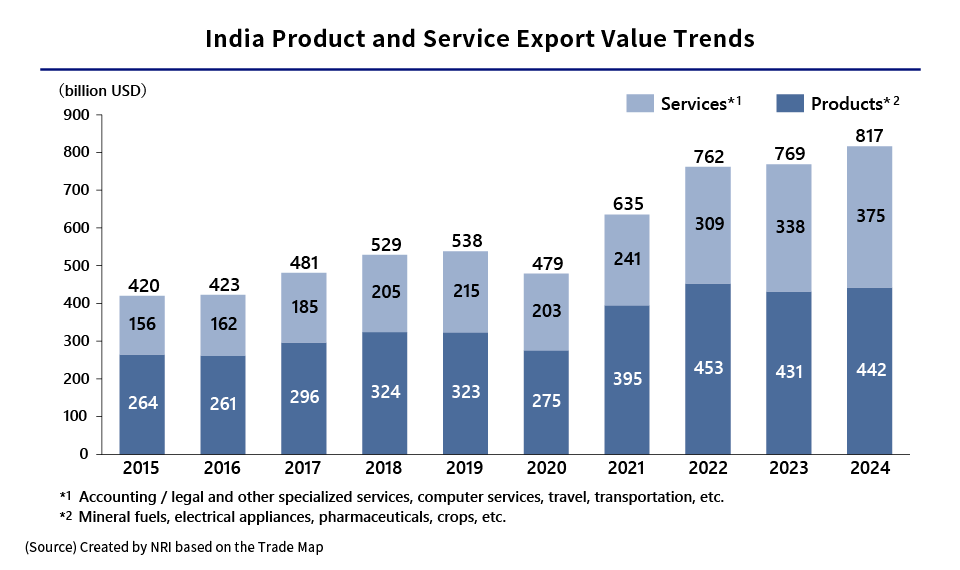
Of course, there still remain certain challenges, namely in terms of infrastructure, regulations, and regional disparities. Nevertheless, changes in the form of increasingly sophisticated export structures and a growing concentration of R&D bases are slowly starting to manifest, as seen for instance in recent export trends and investment trends among global enterprises.
If we perceive India simply as a market, we might overlook its true essence. Going forward, the question of how to create not only a strategy for selling in India, but also a strategy for leveraging India to compete globally, will surely be a key management theme.
Profile
-
Yutaka GoPortraits of Yutaka Go
NRI INDIA
-
Satoru IshigakiPortraits of Satoru Ishigaki
NRI INDIA
-
Yusuke NumataPortraits of Yusuke Numata
NRI INDIA
-
Dai WatanabePortraits of Dai Watanabe
NRI INDIA
-
Mai HasegawaPortraits of Mai Hasegawa
NRI INDIA
-
Tatsuki HimonoPortraits of Tatsuki Himono
NRI INDIA
-
Yudai SasakiPortraits of Yudai Sasaki
NRI INDIA
* Organization names and job titles may differ from the current version.