
Ever since the U.S. and Israel struck Iran at the end of February 2026, the Strait of Hormuz has remained essentially locked down, and this has led to a sharp reduction in the global crude oil supply. On April 8, it was reported that the U.S. and Iran had agreed to a two-week ceasefire, but the outlook for the crude oil supply still remains uncertain. As oil prices soar and the risk of supply shortages keeps mounting, Asian countries in particular have begun rolling out measures to curb the consumption of electricity and petroleum products. Although Japan has yet to implement any such measures, in the near future, the government may start asking people and companies to exercise voluntary restraint and cut back on their use of electricity and petroleum products. And if those calls for restraint become restrictions, there could be major adverse effects for the Japanese economy.
Will we soon hear calls to voluntarily use less electricity and gasoline?
Meanwhile, although the Japanese government has stated that “We will not rule out any possibilities, and will respond flexibly”, it has also said that there are no problems with the oil or electricity supply at present, and thus it will not be asking the public to cut back on their electricity or gasoline consumption at this time. That the government has not budged from its careful approach could mean that it fears any calls for voluntary restraint could create confusion among the public and potentially spur a rush to quickly buy up crude oil-related products, which in turn could exacerbate supply shortages and send prices skyrocketing further. It is believed that during the first oil crisis in the 1970s, the government’s calls to conserve paper triggered the panic buying of toilet paper, and this too has likely led the government to take a more cautious stance.
In addition, given what happened during the COVID-19 pandemic, the government is presumably also concerned that asking for voluntary restraint could have negative effects on economic activity and spark public discontent, leading to criticism of the government.
However, unless crude oil imports through the Strait of Hormuz return to normal, at some point the supply of gasoline and other petroleum products in Japan will run out, and the supply of electricity will be reduced. To postpone the timing of this eventuality as much as possible, requests for voluntary restraint should probably be considered sooner rather than later.
Gasoline subsidy budget set to run out; potential for subsidies to be reduced and gasoline prices to rise as well
In a more pessimistic scenario, in which a further rise in overseas crude oil prices would lead the amount of the subsidies to be increased to 60 yen per liter, the budget would be depleted on May 29 (Fig. 1).
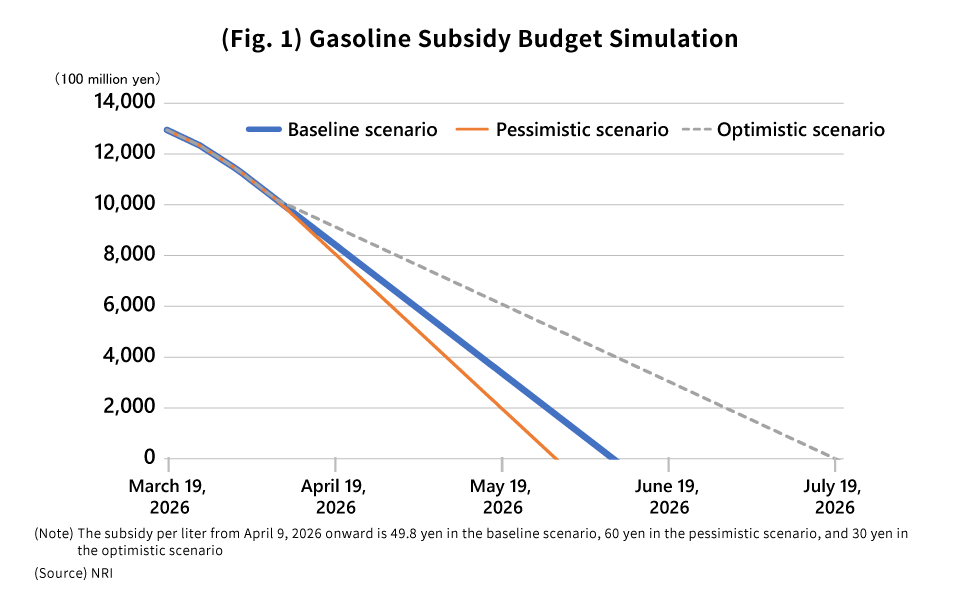
Even if the budget that is currently secured does run out, it is very likely that the government will secure a new budget to keep the subsidy program going. However, it is also conceivable that the current gasoline subsidy program will be revised to shrink the subsidy amount. That would probably bring about a moderate increase in gasoline prices.
Assuming that the government does reduce the subsidy amount, its primary aim will be to lessen the associated fiscal burden. The price of gasoline for wholesalers is, presumably, determined mainly by overseas crude oil prices. Under the current government subsidy program, which keeps the average price of regular gasoline nationwide at around 170 yen per liter, the subsidy amount grows as the price of crude oil rises, and this puts pressure on the country’s fiscal situation overall.
The secondary aim would be to urge individuals to consume less gasoline. The government will likely end up calling on the public to curb their gasoline consumption at some point, but keeping gasoline prices relatively low through subsidies would only hinder such conservation efforts.
There is the possibility that the gasoline subsidy may be reduced as early as May, and the price, which is currently around 170 yen per liter, could go up to 180 yen or 190 yen, or perhaps even as high as 200 yen. But in that event, benefit payments or some other type of assistance will surely need to be provided to low income earners, whose livelihoods are apt to be dealt a major blow by rising gasoline prices.
Hypothetically, if the government were to reduce the subsidy and allow gasoline prices to rise as far as 200 yen per liter, the price of gasoline would rise by 17.6% compared to the 170 yen-per-liter level. Households of two or more persons consumed 72,474 yen worth of gasoline on average in 2025, and if that amount increases by 17.6%, it will cost households another 12,755 yen per year.
Just how much crude oil has Japan secured?
While the government has begun releasing some of its crude reserves, it is also scrambling to procure crude oil from alternative routes that do not pass through the Strait of Hormuz. Japan had been importing 90% or more of its crude oil through the Strait. By contrast, approximately 20% of the world’s total crude oil supply had been provided via the Strait. With the Strait of Hormuz effectively being locked down, the nations of the world have been competing with each other to obtain more oil. With that happening, for Japan to cultivate an alternative route bypassing the Strait of Hormuz and thereby procure crude oil in a new way is no simple matter.
As the world’s largest oil producer, the U.S. accounted for 3.8% of Japan’s oil imports in 2025. Apart from the Middle Eastern nations, it is the largest oil exporter to Japan. Moreover, at the Japan-U.S. summit meeting held in March, the two countries agreed that Japan would import more crude oil produced in the U.S. From this standpoint, the U.S. is the source from which Japan can most realistically try to expand its crude oil procurement through alternative routes.
In fact, at a press conference on April 7, Prime Minister Takaichi explained that crude oil imports from the U.S. are expected to be nearly four times higher year-on-year in May.
However, there could be problems with trying to stably increase crude oil imports from the U.S. and to maintain them at that higher level going forward. First, with the war in Iran tightening global oil supplies and making it difficult to import crude oil from overseas, it is conceivable that the U.S. may take a more cautious approach to its crude oil exports in order to give priority to meeting its own domestic demand.
Second, the oil coming from the U.S. mainland is light crude oil. The majority of Japan’s oil refining facilities handle heavy crude oil produced in the Middle East, and therefore even if crude oil imports from the U.S. were expanded, Japan might face another potential problem in that the work of refining this oil to produce petroleum products would not happen overnight.
Third, Japan is expected to play a supporting role in ensuring that other Asian nations—which are heavily dependent on crude oil imports coming through the Strait of Hormuz—can secure their own supplies. It would be a problem if Japan scrambled to procure crude oil from the U.S. or other countries only for its own needs.
Furthermore, it would seem that the procurement of crude oil by alternative routes could include the Red Sea route, by which Saudi Arabian crude oil is purchased through an East-West pipeline. Whereas the amount of crude oil supplied through the Strait of Hormuz is estimated to be around 20 million barrels per day, the supply of Saudi Arabian crude oil via the Red Sea route is said to be about one-quarter of that at about 5 million barrels per day. While this is a leading alternative route for procuring crude oil, the Iran-backed Houthi rebel group in Yemen has joined in the hostilities, which puts the crude oil supply via the Red Sea route at risk of being cut off as well.
Given the points above, it would appear that the option of procuring more crude oil from alternative routes which bypass the Strait of Hormuz and maintaining that arrangement is still limited.
Prime Minister Takaichi explained that procurement from alternative routes is expected to account for at least 20% of the previous year’s volume of crude oil imports in April and there are prospects for procuring more than half of such imports from those sources in May, and there are even expectations for securing the nation’s crude supply beyond this year. Yet even so, the fact remains that unless the Strait of Hormuz is reopened, Japan’s oil stockpile will ultimately run out sooner or later.
In the interest of delaying the timing of this crude oil supply shortage as much as possible, as well as of making energy consumption yet more efficient, I believe the government must ask people and companies to cut their consumption of electricity and petroleum products sooner rather than later, and gradually intensify these efforts as the situation develops.
Economic impact if strong restrictions (such as cuts to the electricity supply) are issued
A useful reference in considering the government’s response to soaring crude oil prices and oil supply shortages would be how it handled the first oil crisis in the 1970s. At that time, the government asked people and companies to conserve electricity and energy in the following ways.
・Voluntarily refraining from using private cars on Sundays (refraining from Sunday driving)
・Encouraging lower-speed driving on highways
・Lowering thermostat temperature settings for heating (implemented as a symbolic energy conservation gesture)
・Reducing non-essential use of lighting and electricity (including neon lights and billboard illumination)
・Refraining from late-night television broadcasting
Unless the situation surrounding the Strait of Hormuz takes a favorable turn, the government will have to consider that perhaps even harsher restrictions than these will need to be rolled out.
During the first oil crisis in the 1970s, the government reduced the supply of electricity to large electricity consumers by 15% for a period of three and a half months. While I think the chance that such strong restrictions could be taken anytime soon remains low, if similar measures were to be taken some point down the road, my calculations show that Japan’s real GDP would be brought down by an annualized 0.94%. That figure comes from the following formula.
Annualized impact to real GDP = (percentage of corporate production made up by large consumers using 500kW of contracted power or more [37.5%] × (electricity supply reduction rate [15%]) × (length of electricity supply restrictions [3.5 months ÷ 12 months]) × (rate of production decline if electricity supply falls by 1% (elasticity) [0.57]) = 0.94%
Will individual behavior really change?
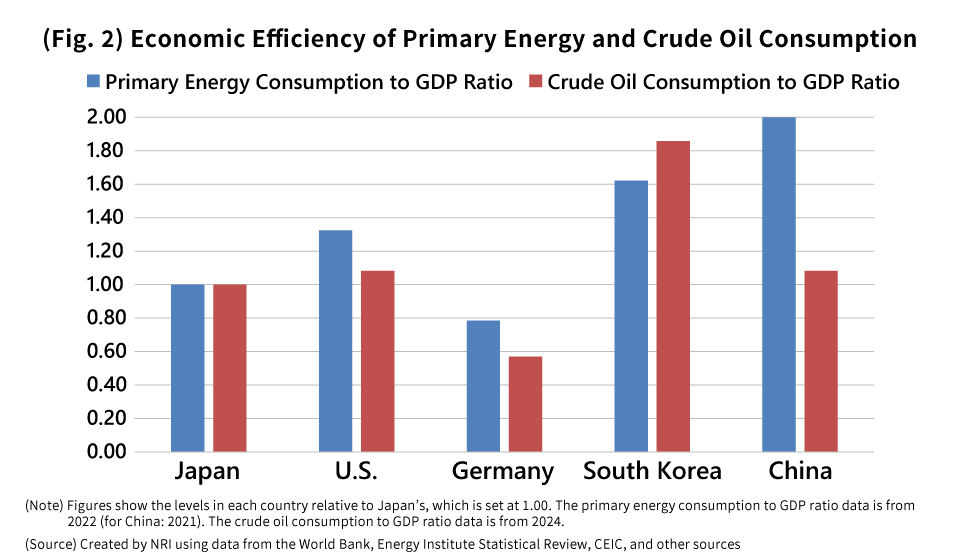
The first oil crisis was the impetus for Japan to significantly improve its energy efficiency. Fig. 2 shows that crude oil consumption in Japan as a percentage of the economy is relatively high compared to primary energy consumption as a percentage of the economy. This surely signifies that Japan has not managed to adequately reduce its dependence on crude oil. One might hope that the heightening tensions in the Middle East will prompt Japan to undertake more aggressive efforts to get off of crude oil, and in turn, to make the transition to a carbon-neutral society.
Profile
-
Takahide KiuchiPortraits of Takahide Kiuchi
Executive Economist
Takahide Kiuchi started his career as an economist in 1987, as he joined Nomura Research Institute. His first assignment was research and forecast of Japanese economy. In 1990, he joined Nomura Research Institute Deutschland as an economist of German and European economy. In 1996, he started covering US economy in New York Office. He transferred to Nomura Securities in 2004, and four years later, he was assigned to Head of Economic Research Department and Chief Economist in 2007. He was in charge of Japanese Economy in Global Research Team. In 2012, He was nominated by Cabinet and approved by Diet as Member of the Policy Board, the committee of the highest decision making in Bank of Japan. He implemented decisions on the Bank’s important policies and operations including monetary policy for five years.
* Organization names and job titles may differ from the current version.