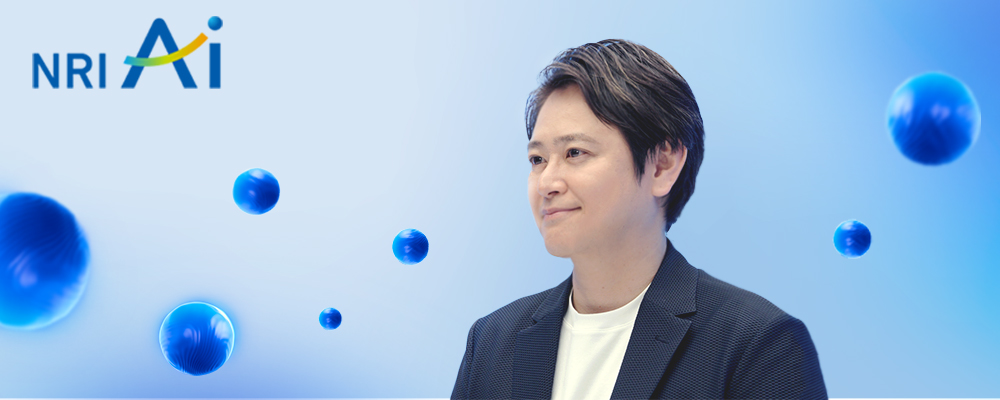
“I want to create an era in which people can focus on what they enjoy and on what they want to do.” Taking this idea from a mere blueprint and turning it into reality with a robust technology is the mission of Kouta Iwanaga, who is in charge of constructing AI platforms and implementing AI governance at Nomura Research Institute (NRI). He is finding solutions by “getting hands-on” in fields where no correct answers yet exist.
Making it possible for “anyone to do it”, and looking toward the next unknown
Iwanaga joined NRI’s Fukuoka Development Center in 2008. Given his experience at a prior position handling server and database migration and operations management, he found himself engaged in platform building and operations as a database specialist.
“I was put in charge of a project for introducing a database called Oracle Exadata, which had just been released at the time, to SaaS systems for financial institutions. This was a time when databases at financial institutions were typically mainframes, and we were taking on the challenge of introducing this platform for the first time in Japan for use in financial institutions’ systems.”
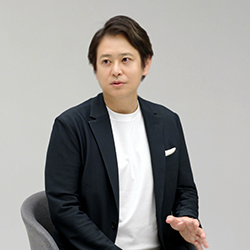
His mindset of turning the technologies he has cultivated into organizational standards and then looking towards the next “unknown” has served to propel Iwanaga’s career into the world of big data and edge AI.
“Even in those days, NRI had viewed operational dependence on individual persons as a risk, and so in parallel with development, we sought to standardize everything from design to rollout, putting a framework in place enabling anyone to promote projects. That ultimately led to the end of the work I was doing. But that’s all right. I did have a career I was pursuing as a database specialist, but I also saw this as a chance to learn something new that no one had done before.”
After this implementation was completed successfully, similar projects were launched one after another for other NRI systems for financial institutions. However, the actions Iwanaga took in the course of developing his expertise consisted of making technologies thoroughly standardized, rather than gatekeeping them.
“Too crowded” —a new crowd-detecting technique from a one-month burst of rapid development
Iwanaga came to be well known within NRI as a formidable engineer in new research areas close to hardware after a project he took on during the COVID-19 pandemic: he developed a “3Cs detection” solution that detected when a conference room was overly crowded and issued an alert.
“In mid-April 2020, we were told that the company wanted to release it after Golden Week at the latest. With the novel Coronavirus raging, I wanted to meet this critical challenge of rapidly ensuring workplace safety, and it was an extremely short window, but I focused hard and got to work. It worked by using a small AI device placed below a display, to analyze camera images in real time as a way of identifying who was wearing masks and the concentration of people in the room. We deployed a kind of edge computing technology that works even in places where networks can’t reach.”
With limited expertise inside the company, Iwanaga worked with a PC manufacturer to refine the AI processing method running on the device in a short timeframe, and this 3Cs solution was indeed deployed in conference room at NRI’s headquarters after Golden Week. What supported Iwanaga at this time was his experience from an R&D project in which he installed a small computer in a mini-4WD to verify the possibilities of edge computing with his own hands.
No standards in place means getting hands-on until the job is done
Currently, Iwanaga is working to build an “AI common infrastructure”. In particular, his focus is on how to systematically implement the kind of “AI governance” that can ensure AI safety. With the rapid proliferation of generative AI, companies now need to maintain strict governance, but many of the guidelines that exist are still in the abstract stage.
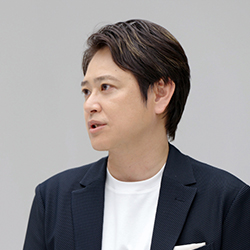
“In order to decide on the service and the level of acceptable risk, you have to get personally involved hands-on to see first of all whether those are reliable standards. This means actually creating a system, establishing test items, and verifying whether the specifications function as envisioned. There are no known correct answers, so you have to get things to a state where you yourself can be confident that what you’ve done is correct. By building up a track record of test results from actual equipment as well as a logical foundation, step by step you’ll reach a consensus with the client.”
“The guidelines out there do point out the risks in terms of what needs to be considered, but there are still no answers when it comes to the kinds of specific definitions needed in order to run this technology as a system,” he says. Iwanaga is searching each day for ways of integrating that abstract concept into concrete functional requirements. What he stresses in this regard is, once again, the definite need to “get hands-on.”
Toward a future where people can concentrate on what they enjoy
What Iwanaga is looking ahead to now is the new form of society that lies beyond the technology of AI. He is exploring the uncharted territory of creating standards for AI systems because he believe doing so is an essential requisite for achieving practical implementation throughout society.
“It’s clear that Japanese society can’t go on the way it has amid the ongoing population decline. Given the circumstances, the use of AI and robots will likely become an essential condition. In particular, NRI’s clients are operating systems that could be called the infrastructure of daily life, with huge societal significance. The issue is to integrate AI with those systems, and then to run operations that way. Accomplishing that would be the most rewarding challenge.”
Calmly discussing this future which no one has yet experienced, Iwanaga has his sights not on the technologies themselves, but rather a future for people that will be unlocked by those technologies.
“We’ve entered an era in which the tedious work that simply had to be done by human beings, and that couldn’t be fully systematized, can now be done by AI. I hope we will soon see a time in which people can get away from such work, so that they can focus more on what they enjoy, and on what they want to do.”
Profile
-
Kota IwanagaPortraits of Kota Iwanaga
Fukuoka Solution Development Department I
After working at a Japanese System Integrator company starting in 2005, joined Nomura Research Institute (NRI) in 2008. Gained experience in database construction and related projects for systems used at financial institutions. Subsequently, he led R&D efforts for an AI system/MLOps platform centered on edge AI, as well as solutions development. Currently, he is engaged in the development of the AgentOps platform focused on governance. He is an NRI-certified IT architect.
* Organization names and job titles may differ from the current version.