Executive Summary
This report provides a systematic overview of what fermentation is by organizing its definitions and various perspectives while introducing the potential of fermentation as an increasingly familiar part of everyday life, not only through fermented foods, but also through its broader applications.
It also examines key trends in the fermentation market, highlights important market developments, explores how fermentation can help address social challenges, and discusses business opportunities arising from fermentation, along with recommendations for future initiatives.
What Is Fermentation?
Fermentation is a biological process in which microorganisms such as molds, yeasts, and bacteria, break down and synthesize organic compounds, including carbohydrates and proteins, resulting in chemical transformations. Because these processes produce outcomes that are beneficial to humans, such as improved preservation, enhanced nutritional value, and richer flavor, fermentation has long been utilized in everyday life. In contrast, putrefaction also results from the activity of microorganisms but produces substances that are harmful or undesirable to humans.
For Japanese people, fermentation is most closely associated with food. In addition to soy sauce, miso, sake, yogurt, and bread, products such as kombu (kelp) and katsuobushi (dried bonito flakes) are also products of fermentation.
The applications of fermentation extend far beyond food. Fermentation is used to produce a wide range of products, including pharmaceuticals such as vaccines and antibiotics, as well as industrial products including synthetic fuels and foaming agents.
Precision Fermentation: Innovative Technology
There is also a form of fermentation called precision fermentation.
Precision fermentation combines traditional fermentation processes with advanced biotechnology to efficiently produce targeted substances by breaking down and synthesizing organic compounds, thereby altering characteristics such as flavor, composition, and color.
This technology genetically engineers the microorganisms responsible for fermentation so that, through their metabolic processes, they produce specific target compounds, such as proteins. For example, rather than producing protein directly from animals, microorganisms can be used to produce proteins that serve as the basis for alternative meat products through fermentation.
It should be noted that aging (maturation) differs from fermentation. Aging refers to changes in flavor and umami resulting from the breakdown of substances by enzymes naturally present within the food itself, rather than by the action of microorganisms.
The History of Fermentation
The history of fermentation dates to the Neolithic period, before the Common Era.
Alcoholic beverages and cheese are believed to have been among the earliest fermented products. For example, Georgia, in the Caucasus region, is widely regarded as the birthplace of wine. With a history spanning approximately 8,000 years, wine represents one of humanity's oldest fermentation technologies. Not only wine, but also alcoholic beverages made for purposes such as religious ceremonies were produced through fermentation and have a long history.
In Japan, the Kojiki (Record of Ancient Matters) describes the use of Yashiori no Sake ("Eightfold Refined Sake") in the legend of the slaying of the eight-headed serpent Yamata no Orochi.
Cheese is believed to have originated in Mesopotamia. According to an Arabian folktale, a merchant traveling across the desert carried milk in a canteen made from a sheep's stomach and tied it to a camel. When he later attempted to drink the milk, he discovered white curds inside—the legendary origin of cheese.
Although fermentation was initially discovered by chance, it is believed to have first been utilized as a method of food preservation.
A major turning point in the scientific understanding of fermentation came in the nineteenth century through the work of the French chemist and microbiologist Louis Pasteur. At the time, alcoholic fermentation was widely believed to be a purely chemical process. Pasteur demonstrated that fermentation is the result of the activity of living microorganisms, specifically yeast, thereby providing the first scientific explanation of the biological nature of fermentation.
Pasteur also discovered that invisible microorganisms were responsible for disease and spoilage, fundamentally transforming scientific understanding of infectious diseases. His work ultimately led to the development of vaccination and sterilization methods that helped protect humanity from infectious diseases.
In the modern era, fermentation began to be used for industrial applications around the 1930s. Compared with the thousands of years of fermentation history, the commercialization of fermentation as an industrial technology is relatively recent.
The following sections examine fermentation from several different perspectives, including the types of microorganisms involved, raw materials, production processes, and intended purposes.
Perspectives on Fermentation
Perspective 1: Types of Microorganisms
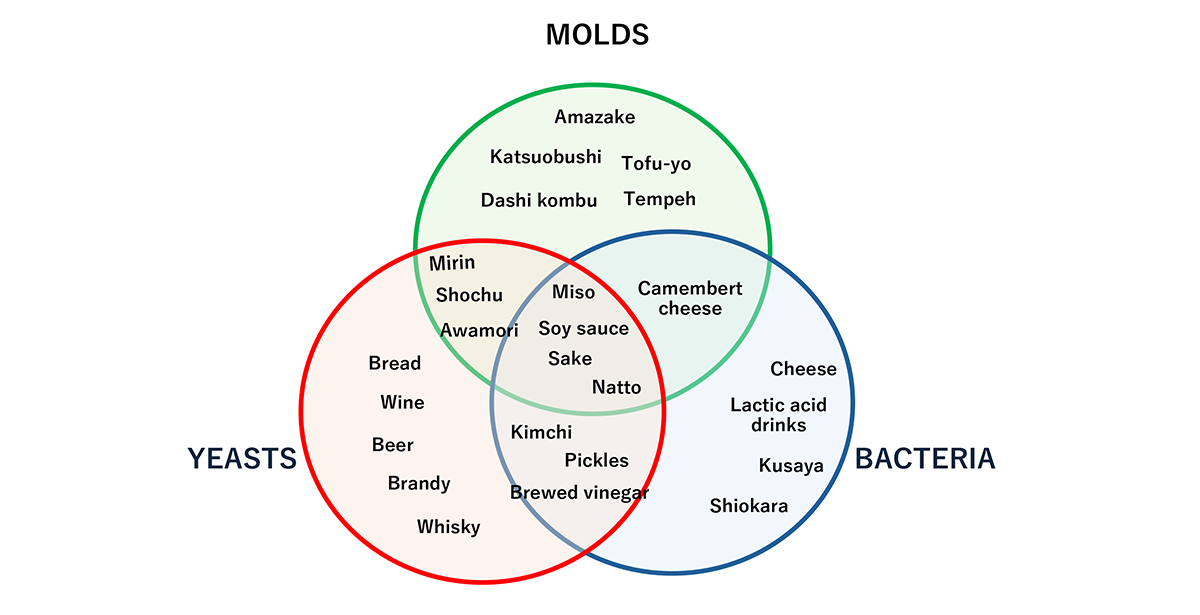
Fermentation can first be understood by examining the characteristics of the microorganisms involved, including molds, yeasts, and bacteria, along with examples of the products they produce.
In terms of size, microorganisms generally follow the order of bacteria < yeast < mold. They are described below in that order.
- ■ Bacteria (Lactic Acid Bacteria, Bacillus subtilis (Natto), Acetic Acid Bacteria)
Bacteria exist in various forms, including spherical (cocci), rod-shaped (bacilli), and spiral (spirilla) organisms. They reproduce by cell division.
Products include yogurt, kimchi, natto, and vinegar. - ■ Yeast (Baker's Yeast, Brewer's Yeast, Yeast)
A type of fungus, with the characteristic of breaking down glucose into alcohol and carbon dioxide gas.
Products include wine, beer, and bread. - ■ Molds (Koji Mold, Katsuobushi Mold, White Mold, Blue Mold)
Molds are filamentous fungi that grow by extending thread-like structures called hyphae.
Typical products include sake, miso, katsuobushi (dried bonito flakes), and cheese. Koji mold is unique to Japan and is cultivated by allowing it to grow on steamed grains. It plays a central role in Japanese fermentation by breaking down starch into sugars and proteins into amino acids.
Traditional Japanese fermented foods such as miso, soy sauce, rice vinegar, and sake rely on the combined activity of bacteria, yeast, and molds, including koji mold, yeast, lactic acid bacteria, and acetic acid bacteria. These traditional foods demonstrate the extensive use of fermentation to develop flavor, preserve food, and enhance nutritional value.
Figure 1. Types of Microorganisms
Source: NRI
Perspective 2: Types of Raw Materials
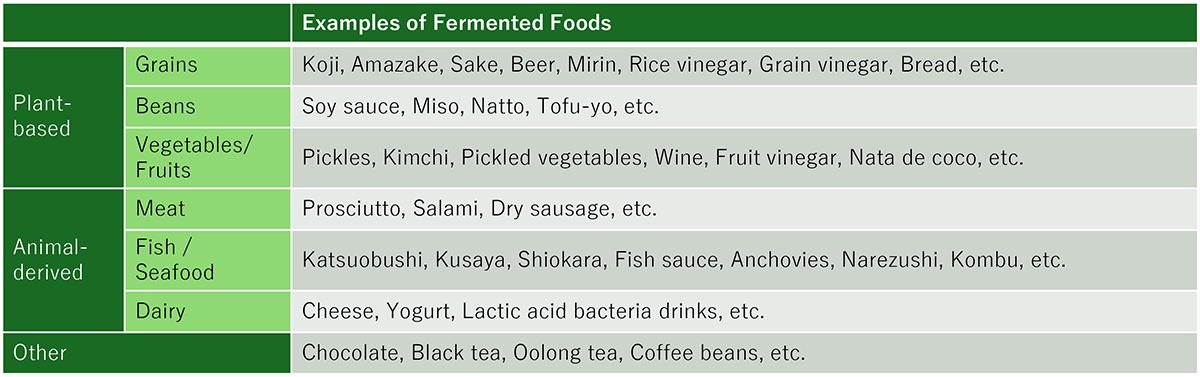
Fermentation can also be categorized according to the raw materials used. These include plant-based ingredients such as grains and vegetables, as well as animal-derived ingredients such as fish and meat.
Organizing fermented foods by their primary raw materials highlights the wide variety of familiar foods that are produced through fermentation and illustrates how deeply fermentation is integrated into everyday diets.
Figure 2. Types of Raw Materials
Source: NRI
Perspective 3: Production Process (Industrial Applications of Fermentation)
From a manufacturing perspective, the fermentation production process can be broadly divided into two stages: upstream processing and downstream processing. This section introduces the industrial application of precision fermentation and collaborative initiatives involving multiple organizations.
Figure 3. Production processes in fermentation and characteristics of Industry
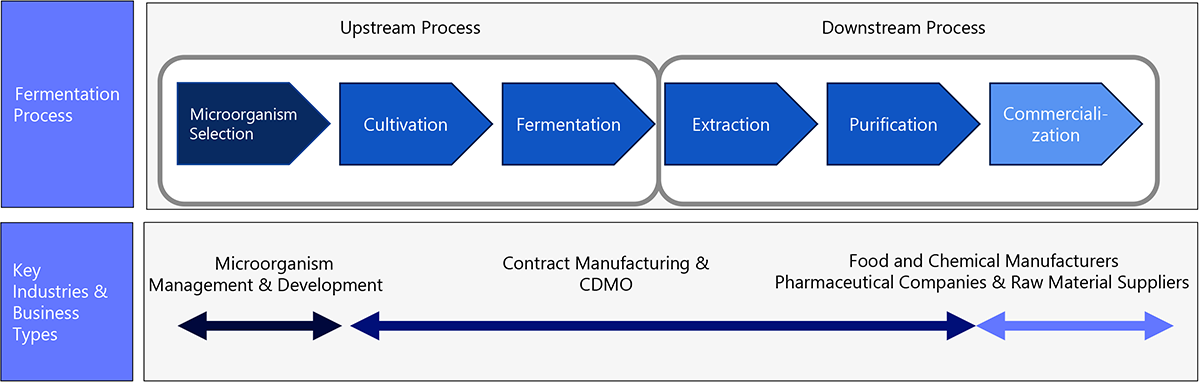
※Some major manufacturers handle both upstream and downstream processes.
Source: NRI
Upstream processing refers to the production of target substances through microbial growth and fermentation. This stage includes activities such as microbial cultivation, fermentation tank operation, and culture media preparation. It encompasses the entire initial phase of cultivating microorganisms and producing the desired compounds.
Upstream processing is critically important because it has a significant impact on the quality and efficiency of downstream purification and product manufacturing.
Downstream processing involves extracting, purifying, and commercializing the target substances produced during fermentation. Typical processes include filtration, centrifugation, purification, concentration, drying, and quality inspection.
Some large corporations manage the entire value chain, from microbial development and cultivation to commercialization, within their own organizations. However, many companies specializing in microbial design, cultivation, and fermentation are dedicated fermentation businesses or startups.
Companies seeking to incorporate fermentation into their businesses will often need to collaborate with these specialized firms and startups. Depending on the circumstances, they may also need to support these partners to accelerate technology development and commercialization.
In Europe, collaboration between companies from different industries, as well as partnerships between industry and academia, has already become well established. One example includes an initiative involving Asahi Group Foods, Ltd. The project focuses on developing dietary fiber with health benefits, including improvements to gut health, through yeast fermentation. In addition to product development, the initiative addresses safety, regulatory compliance, consumer acceptance, and ultimately the establishment of a sustainable food supply.
Commercialization often requires a lengthy process involving research and development, capital investment, manufacturing scale-up, marketing, and the establishment of industry standards. For startups with promising technologies but limited access to funding, partnerships with large companies that possess financial resources and established distribution networks can create mutual benefits.
Similarly, collaboration among multiple companies can enable achievements that would be difficult for a single organization alone, including regulatory compliance and building consumer understanding and acceptance.
Perspective 4: Purpose
In Japan, fermentation is widely recognized as a familiar part of everyday food culture. In many other countries, however, fermentation is often viewed primarily as a technology or functional capability.
Originally developed as a method of preserving foods such as wine and cheese, which are believed to be among the earliest fermented products, fermentation has since been used to enhance flavor, aroma, color, and nutrient absorption.
More recently, precision fermentation has attracted considerable attention for its technological capabilities, including large-scale production and the development of functional products such as probiotics and antibiotics.
Functional Benefits of Fermentation
- Food preservation
- Enhanced umami
- Improved aroma
- Enhanced color
- Improved nutrient absorption
- Other functional benefits
The Expanding Fermentation Industry and Its Market Potential
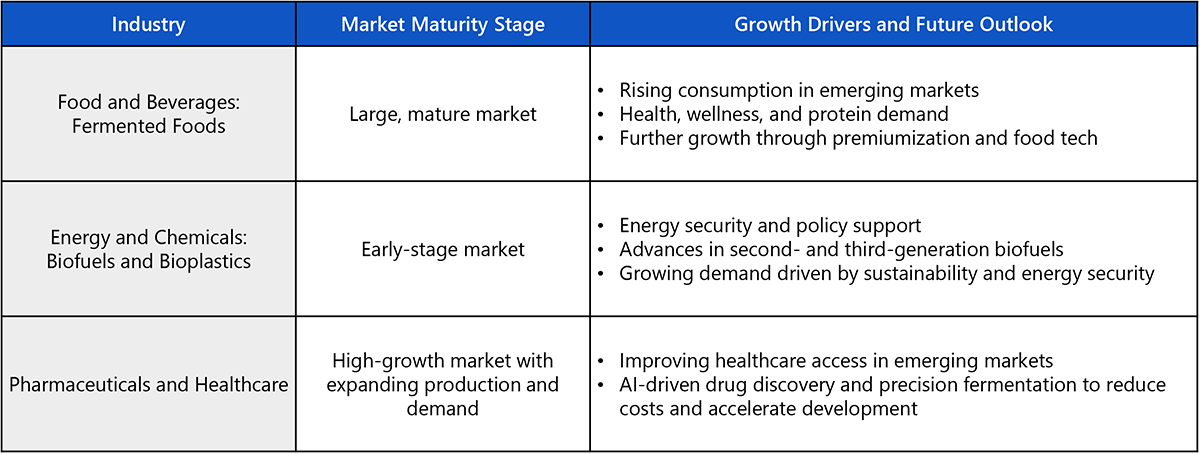
Although the fermentation market is often associated primarily with fermented foods, it encompasses a much broader range of fields, including fermented foods, fermentation-derived chemicals, precision fermentation, and fermentation-based raw materials. Beyond food, fermentation supports industries such as pharmaceuticals and fuels, each representing substantial global markets.
The fermentation ecosystem also includes related fields such as fermentation technologies and intellectual property associated with microorganisms. As these areas are expected to experience rapid growth, understanding how to evaluate their market potential and identify business opportunities will become increasingly important in assessing the overall fermentation industry.
The fermentation market, particularly the fermented food sector, already represents a significant global industry. Growing consumer interest in health and well-being continues to drive expansion in the fermented food market.
Japanese cuisine and traditional fermented foods, including miso and soy sauce, are attracting increasing attention both domestically and internationally. At the same time, rising interest in gut health has accelerated demand for probiotics, and dairy products such as yogurt that contain live beneficial microorganisms are expected to continue supporting market growth.
The diversification of alcoholic beverages, including the craft beer movement, wine, sake, and whisky, has also contributed to market expansion. Premium products with higher added value are becoming increasingly common, further strengthening growth prospects worldwide.
The market ranges from everyday food products to premium wines and whiskies that command exceptionally high prices as investment assets. As a result, continued market expansion is expected. Interest is also growing in microbial strains, such as lactic acid bacteria, as valuable intellectual property.
In addition, fermentation technologies are playing an increasingly important role in addressing the global protein crisis through products such as alternative meat and other protein alternatives.
Recent geopolitical developments, including tensions in the Middle East Crisis and Hormuz Strait Crisis, have accelerated efforts to replace fossil fuel-based products with bio-based alternatives.
Examples include the adoption of biofuels in the automotive, aviation, and maritime industries, the transition from petroleum-based plastics to bioplastics, and the replacement of chemical fertilizers with biofertilizers that utilize microorganisms such as lactic acid bacteria. These developments have drawn increasing attention to fermentation as the underlying production technology that enables these alternatives.
In countries where agriculture is a major industry, disruptions in the supply of chemical fertilizers can significantly affect agricultural productivity. India, for example, has already begun shifting toward fertilizers produced through fermentation, including domestically produced biofertilizers.
The biofuel market is also strongly influenced by environmental policies and regulations. Requirements for Sustainable Aviation Fuel (SAF) and mandatory blending ratios are expected to be major drivers of future market expansion.
Within the pharmaceutical and healthcare sectors, vaccines that gained widespread attention during the COVID-19 pandemic are also produced using precision fermentation technologies.
As healthcare infrastructure continues to improve in emerging and developing countries, demand for pharmaceuticals and vaccines is expected to increase. Market growth will likely be supported by higher consumption volumes as well as the development of new medicines.
Looking ahead, additional growth is anticipated through the acceleration of AI-assisted drug discovery and the expanding market for biologics, pharmaceuticals manufactured using living organisms through technologies such as genetic engineering and cell culture.
Figure 4. The Expanding Fermentation Industry
Source: NRI
Social Challenges Addressed by Fermentation and Business Opportunities
The preceding sections have outlined the definition of fermentation, different perspectives on fermentation, and the market potential of the fermentation industry.
The next step is to view this expanding market through a business lens and identify opportunities for value creation. It is necessary to build a highly profitable business model that targets both domestic and overseas markets.
The food and agriculture sectors comprise many small-scale businesses, and challenges remain in areas such as microorganism management, microbial development, and intellectual property protection.
For example, in Bulgaria, the government manages the country's yogurt-producing lactic acid bacteria. Partnerships involving these bacterial strains are generally established with only one company in each country, creating a well-defined business model for managing and commercializing microbial resources. In Japan, Meiji Co., Ltd. is the only company authorized to manufacture and sell yogurt using the "Bulgaria" name.
In addition to preserving traditional foods and food culture, there may be opportunities to strengthen competitiveness by developing new microbial strains, improving existing varieties, establishing intellectual property and management frameworks, and commercializing these assets.
Fermentation also offers opportunities to address a wide range of social challenges.
These include supporting responses to climate change, decarbonization, and energy security; utilizing underused regional resources to revitalize local economies through food, tourism, and new industries; and strengthening international competitiveness by accelerating innovation and business development.
Business opportunities related to fermentation are expected to emerge across a wide range of industries.
Fermentation is evolving beyond the traditional domains of food and biotechnology. Through cross-industry collaboration, platform-based business models, and the creation of entirely new businesses, fermentation has the potential to become a powerful driver of innovation and value creation across the broader economy.
References
- Food and Agriculture Organization of the United Nations (FAO)
- Organization for Economic Co-operation and Development (OECD)
- International Energy Agency (IEA)
- World Health Organization (WHO)
- United Nations Children's Fund (UNICEF)
- International Organization of Vine and Wine (OIV)
- Brewers Association
Overview of Fermentation: Expanding Market Potential and Business Opportunities
Author Information
-
- Author
- Mayuko Taniguchi
- Department
- Senior Researcher
- Organization names and Job titles
- Consulting Business Development Department